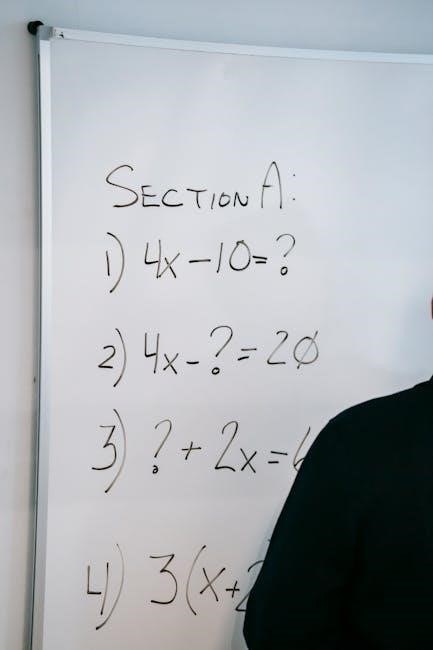
Order of Operations Worksheet Grade 6 PDF: Article Plan
This article details a comprehensive plan for a Grade 6 Order of Operations worksheet‚ covering essential concepts like PEMDAS/BODMAS.
It explores worksheet types‚ features‚ common errors‚ and valuable resources for effective learning and practice.
The order of operations is a fundamental concept in mathematics‚ establishing a standardized sequence for evaluating expressions. For Grade 6 students‚ mastering this skill is crucial for building a strong foundation in algebra and more advanced mathematical concepts. An order of operations worksheet specifically designed for this age group provides targeted practice‚ reinforcing the correct procedures.
Without a defined order‚ the same expression could yield multiple‚ different answers‚ leading to confusion and inaccuracies. These worksheets typically introduce the acronyms PEMDAS or BODMAS – mnemonic devices to help students remember the sequence: Parentheses/Brackets‚ Exponents/Orders‚ Multiplication and Division (from left to right)‚ and Addition and Subtraction (also from left to right).
Effective worksheets don’t just present problems; they often include explanations‚ examples‚ and step-by-step solutions to guide students through the process. Understanding why the order matters is as important as knowing what the order is. This initial introduction sets the stage for more complex problem-solving later on.
What are Order of Operations?
Order of operations defines the sequence in which mathematical operations must be performed to correctly evaluate an expression. It’s a set of rules ensuring consistency – everyone arrives at the same answer. A Grade 6 order of operations worksheet focuses on solidifying these rules through practice. The core principle revolves around prioritizing operations‚ preventing ambiguity.
Essentially‚ it dictates that calculations aren’t performed from left to right indiscriminately. Instead‚ certain operations take precedence. Parentheses (or brackets) always come first‚ indicating operations that must be completed before anything else. Following that are exponents (or orders)‚ then multiplication and division‚ which share equal priority‚ and finally‚ addition and subtraction‚ also with equal priority.
When multiplication and division‚ or addition and subtraction‚ appear in the same expression‚ they are evaluated from left to right. Worksheets often present problems designed to test this understanding. Mastering these rules is vital‚ as they form the basis for more complex algebraic manipulations encountered in higher-level math courses.
Why is Order of Operations Important?
Understanding the order of operations is fundamental to mathematical accuracy. Without a standardized sequence‚ the same expression could yield multiple‚ different answers‚ leading to confusion and errors. A Grade 6 order of operations worksheet reinforces this crucial concept‚ building a strong foundation for future mathematical studies.
Imagine evaluating “2 + 3 x 4” without rules. Performing addition first (2+3=5) then multiplying (5×4=20) gives one result. However‚ following the correct order (3×4=12‚ then 2+12=14) yields the accurate answer. This illustrates why a consistent approach is essential.
This isn’t merely about getting the ‘right’ answer; it’s about logical thinking and problem-solving. The order of operations mirrors a structured thought process‚ applicable beyond mathematics. It’s vital in fields like computer programming‚ engineering‚ and finance‚ where precise calculations are paramount. Worksheets help students internalize this logic‚ preparing them for more advanced concepts and real-world applications.
PEMDAS/BODMAS Explained

PEMDAS and BODMAS are mnemonics that simplify remembering the order of operations. A Grade 6 order of operations worksheet frequently utilizes these acronyms to guide students through calculations. PEMDAS (Parentheses‚ Exponents‚ Multiplication and Division‚ Addition and Subtraction) is common in the US‚ while BODMAS (Brackets‚ Orders‚ Division and Multiplication‚ Addition and Subtraction) is prevalent in other regions – they represent the same sequence.

Let’s break it down: Parentheses/Brackets indicate operations to be performed first‚ resolving expressions within them. Exponents/Orders (powers and square roots) follow. Multiplication and Division hold equal priority‚ performed from left to right. Finally‚ Addition and Subtraction also share equal priority‚ executed from left to right.
Worksheets often present problems specifically designed to test understanding of this hierarchy. Students learn that ignoring the order leads to incorrect solutions. Mastering PEMDAS/BODMAS isn’t about memorization alone; it’s about understanding why this order exists – to ensure consistent and unambiguous mathematical results.
Understanding Parentheses/Brackets
Parentheses ( ) and brackets [ ] are crucial in the order of operations‚ signifying that the expressions within them must be simplified first. A Grade 6 order of operations worksheet heavily emphasizes this rule‚ often presenting nested parentheses to challenge students. These grouping symbols dictate priority‚ overriding the standard PEMDAS/BODMAS sequence.
Consider the expression 2 x (3 + 4). The parentheses instruct us to add 3 and 4 before multiplying by 2. Ignoring this would yield a different‚ incorrect answer. Worksheets frequently include problems with multiple sets of parentheses‚ requiring students to work from the innermost set outwards.
Brackets function identically to parentheses; they simply offer another way to group operations. Students must recognize that both symbols demand immediate attention. Mastering this concept is fundamental‚ as it forms the basis for simplifying more complex algebraic expressions later on. Effective worksheets provide ample practice with varying levels of nested grouping symbols.
Exponents/Orders: A Detailed Look
Exponents‚ or orders‚ represent repeated multiplication‚ and hold a specific place within the order of operations worksheet hierarchy. Typically denoted by a small number written above and to the right of a base number (e.g.‚ 23)‚ exponents indicate how many times the base is multiplied by itself. In this case‚ 2 x 2 x 2.
Grade 6 students are usually introduced to exponents with small‚ whole-number bases. Worksheets focus on calculating these values before proceeding with other operations like multiplication and division. Understanding exponents is vital‚ as they are foundational for algebra and higher-level mathematics.
A well-designed worksheet will present exponents alongside other operations‚ forcing students to correctly identify their priority. For example‚ in the expression 5 + 22 x 3‚ the exponent (22 = 4) must be calculated before multiplication and addition. Reinforcing this order through consistent practice is key to building student confidence and accuracy.
Multiplication and Division – Equal Priority
Within the order of operations‚ multiplication and division share equal priority. This means when encountering a problem with both operations‚ students must perform them from left to right‚ just as they read a sentence. A Grade 6 order of operations worksheet will frequently test this concept‚ presenting expressions like 12 ÷ 3 x 2 or 4 x 5 ÷ 2.
Many students mistakenly believe multiplication always precedes division‚ or vice versa; Worksheets emphasize that the correct approach is to evaluate the operations in the order they appear from left to right. This rule prevents errors and ensures consistent results.

Effective worksheets will include a variety of problems with differing arrangements of multiplication and division‚ alongside other operations. This reinforces the understanding that priority isn’t about the operation itself‚ but its position within the expression. Clear instructions and ample practice are crucial for mastering this aspect of the order of operations.
Addition and Subtraction – Equal Priority
Similar to multiplication and division‚ addition and subtraction hold equal priority in the order of operations. A Grade 6 order of operations worksheet will consistently assess a student’s ability to correctly apply this rule. Problems often include combinations like 10 — 4 + 2 or 5 + 7, 3‚ requiring careful evaluation.
Students frequently make errors by performing addition before subtraction (or vice versa) without considering the left-to-right rule. Worksheets are designed to counteract this common mistake by presenting problems where the order significantly impacts the outcome. Emphasizing the left-to-right approach is paramount.
Worksheet design should incorporate varied expressions‚ including those with multiple addition and subtraction operations alongside parentheses‚ exponents‚ multiplication‚ and division. This integrated approach reinforces the complete order of operations and prevents isolated skill application. Step-by-step solutions are beneficial for identifying and correcting errors.
Grade 6 Curriculum Alignment
A well-designed order of operations worksheet for Grade 6 must align with common core standards and national mathematics curricula. Typically‚ sixth-grade students are expected to demonstrate fluency with whole number and decimal operations‚ and applying the order of operations is a crucial component of this skill set.
Worksheets should reinforce concepts introduced in classroom lessons‚ providing ample practice opportunities. The complexity of problems should gradually increase‚ mirroring the progression of the curriculum. This includes starting with simpler expressions involving only addition‚ subtraction‚ multiplication‚ and division‚ before introducing exponents and parentheses.
Effective worksheets also support the development of algebraic thinking‚ a key focus in Grade 6. By mastering the order of operations‚ students build a foundational understanding necessary for evaluating expressions with variables later on. Alignment ensures the worksheet serves as a valuable supplement to‚ rather than a replacement for‚ classroom instruction.
Benefits of Using Worksheets

Order of operations worksheets offer numerous benefits for Grade 6 students learning this critical mathematical concept. They provide focused‚ independent practice‚ allowing students to solidify their understanding at their own pace. Worksheets move beyond simple textbook examples‚ presenting a wider variety of problems to challenge and reinforce skills.
Regular worksheet practice builds fluency and accuracy‚ reducing errors in calculations. The repetitive nature helps to internalize the PEMDAS/BODMAS rules‚ making them second nature. Furthermore‚ worksheets are a cost-effective and accessible learning tool‚ easily printable and distributable for both classroom and home use.
They also serve as a valuable assessment tool for teachers‚ quickly identifying areas where students struggle. This allows for targeted intervention and differentiated instruction. Worksheets promote self-reliance and build confidence as students successfully solve problems independently‚ fostering a positive attitude towards mathematics.
Types of Order of Operations Worksheets (Grade 6)
Grade 6 order of operations worksheets come in diverse formats to cater to varying skill levels and learning needs. A primary distinction lies between easy and hard level worksheets. Easy worksheets typically involve four numbers and three operations – addition‚ subtraction‚ multiplication‚ and division – providing a gentle introduction to the concept.
Harder worksheets increase complexity by incorporating five numbers and four operations‚ demanding more careful application of PEMDAS/BODMAS. Some worksheets focus on specific operation combinations‚ like parentheses with exponents‚ while others present mixed-operation problems requiring students to prioritize steps.
Worksheets can also vary in presentation style‚ including horizontal and vertical layouts‚ word problems requiring translation into mathematical expressions‚ and fill-in-the-blank exercises. Advanced worksheets might introduce the concept of variables‚ preparing students for algebraic thinking. The availability of diverse types ensures targeted practice and skill development.
Easy Level Worksheets: Four Numbers & Three Operations
Easy level order of operations worksheets for Grade 6 are designed to build a foundational understanding of the rules. These worksheets generally present problems involving four numbers and a maximum of three different operations: addition‚ subtraction‚ multiplication‚ and division. The focus is on mastering the basic sequence – parentheses (or brackets)‚ exponents‚ multiplication and division (from left to right)‚ and addition and subtraction (from left to right).
Problems are structured to avoid excessive complexity‚ allowing students to concentrate on applying the correct order rather than getting bogged down in difficult calculations. Examples include expressions like 2 + 3 x 4 ― 1 or 10 / 2 + 5 ― 3.
These worksheets serve as an excellent starting point for students new to the concept‚ reinforcing the importance of following the established order to arrive at the correct answer. They help solidify the PEMDAS/BODMAS framework in a manageable way.
Hard Level Worksheets: Five Numbers & Four Operations
Hard level order of operations worksheets for Grade 6 challenge students with increased complexity. These worksheets feature problems incorporating five numbers and all four basic operations – addition‚ subtraction‚ multiplication‚ and division – demanding a more thorough understanding of PEMDAS/BODMAS. The increased number of operations and operands requires students to carefully analyze each expression to determine the correct sequence of calculations.
Examples of problems found on these worksheets include expressions like 5 x 2 + 10 — 4 / 2 or (3 + 1) x 6 / 2 ― 1. These problems often necessitate multiple steps and a heightened attention to detail to avoid errors. Students must accurately identify and prioritize parentheses‚ multiplication/division‚ and addition/subtraction.
These worksheets are ideal for students who have mastered the fundamentals and are ready to tackle more intricate challenges‚ solidifying their skills and preparing them for advanced mathematical concepts.
Worksheet Features: Answer Keys
A crucial feature of any effective order of operations worksheet‚ particularly for Grade 6 students‚ is a comprehensive answer key. These keys provide immediate feedback‚ allowing students to self-assess their work and identify areas where they may have made mistakes. The answer key isn’t simply a list of correct answers; it serves as a valuable learning tool.
High-quality answer keys present solutions clearly and concisely‚ often mirroring the worksheet’s layout for easy comparison. Some advanced keys go further‚ offering step-by-step solutions alongside the final answer. This detailed approach helps students understand how to arrive at the correct solution‚ reinforcing the order of operations principles.
Answer keys empower independent learning and reduce reliance on teacher intervention for every problem. They also facilitate efficient grading for educators‚ saving valuable time and allowing for focused instruction on areas needing improvement. Accurate and well-presented answer keys are indispensable for maximizing the educational value of these worksheets.
Worksheet Features: Step-by-Step Solutions
Beyond simple answer keys‚ the inclusion of step-by-step solutions significantly enhances the learning experience offered by Grade 6 order of operations worksheets. These detailed solutions break down each problem into manageable steps‚ explicitly demonstrating the application of PEMDAS/BODMAS at every stage. This feature is particularly beneficial for students who struggle with specific aspects of the order of operations.
Effective step-by-step solutions don’t just present the answer; they explain the reasoning behind each operation. For example‚ they’ll clearly indicate why multiplication is performed before addition‚ referencing the established order. This reinforces conceptual understanding‚ rather than rote memorization.


Such detailed guidance allows students to identify precisely where they went wrong in their own attempts‚ fostering self-correction and deeper learning; Educators can also use these solutions to pinpoint common misconceptions within the class‚ tailoring instruction accordingly. Providing step-by-step solutions transforms a worksheet from a practice tool into a powerful teaching aid.
Common Mistakes Students Make
When working with order of operations worksheets‚ Grade 6 students frequently exhibit predictable errors. A prevalent mistake is performing addition or subtraction before multiplication or division‚ disregarding the established hierarchy. Students often process operations from left to right‚ irrespective of precedence‚ leading to incorrect results.
Misunderstanding or incorrectly applying parentheses/brackets is another common issue. Students may not fully grasp that operations within parentheses must be completed first‚ or they might misplace brackets‚ altering the intended calculation. Confusion also arises with exponents‚ particularly when they are not immediately obvious or are combined with other operations.
Furthermore‚ some students struggle with the equal priority of multiplication and division‚ or addition and subtraction‚ leading to errors in the order they are executed. Recognizing these common pitfalls allows educators to provide targeted support and address specific areas of difficulty‚ improving student accuracy and confidence.
Strategies for Solving Order of Operations Problems
Effective strategies are crucial for mastering order of operations problems within a Grade 6 context. The PEMDAS/BODMAS mnemonic serves as a foundational tool‚ reminding students of the correct sequence: Parentheses/Brackets‚ Exponents/Orders‚ Multiplication and Division (from left to right)‚ and Addition and Subtraction (also from left to right).
Encouraging students to rewrite the problem after each step‚ rather than attempting mental calculations‚ minimizes errors. Underlining or highlighting the operation being performed at each stage enhances focus and clarity. Breaking down complex expressions into smaller‚ manageable parts simplifies the process.
Visual aids‚ like flowcharts or step-by-step diagrams‚ can reinforce the order of operations. Regularly practicing with varied worksheets‚ including those with nested parentheses and exponents‚ builds proficiency. Finally‚ emphasizing the importance of checking answers and identifying potential mistakes fosters a growth mindset and improves problem-solving skills.
Resources for Finding Printable Worksheets
Numerous online platforms offer a wealth of printable order of operations worksheets tailored for Grade 6 students. Websites like Math-Drills.com‚ Education.com‚ and K5 Learning provide a diverse range of free worksheets‚ categorized by difficulty level and skill focus. These resources often include answer keys for easy assessment.
Teachers Pay Teachers is another valuable source‚ offering both free and paid worksheets created by educators. These worksheets frequently feature unique problem sets and engaging designs. For more comprehensive practice‚ consider utilizing IXL‚ which provides interactive exercises and tracks student progress.
Common Core Sheets offers worksheets aligned with Common Core standards‚ ensuring curriculum relevance. When selecting worksheets‚ prioritize those with clear instructions‚ varied problem types‚ and step-by-step solutions to support student learning. Remember to preview the content to ensure it aligns with your specific teaching objectives.
Online Order of Operations Calculators
While worksheets are crucial for skill development‚ online calculators can serve as valuable tools for checking answers and reinforcing understanding of the order of operations. Several websites offer free order of operations calculators‚ allowing students to input expressions and instantly see the correct solution.
CalculatorSoup and Symbolab are popular choices‚ providing step-by-step solutions that demonstrate the application of PEMDAS/BODMAS. These calculators can be particularly helpful for complex problems or for students who are struggling to identify errors in their work. However‚ it’s vital to emphasize that calculators should be used as a supplementary tool‚ not a replacement for manual practice.
Encourage students to first attempt solving problems independently using worksheets before verifying their answers with a calculator. This approach promotes critical thinking and solidifies their understanding of the underlying concepts. Utilizing calculators strategically can enhance the learning process and build confidence.
Integrating Worksheets with Other Learning Tools
To maximize learning‚ order of operations worksheets should be integrated with diverse educational resources. Beyond standalone practice‚ consider incorporating interactive games and online quizzes to make learning more engaging for Grade 6 students. Platforms like Khan Academy offer video tutorials and practice exercises that complement worksheet activities.

Real-world problem-solving scenarios can also be utilized. Present students with word problems requiring them to apply the order of operations to calculate costs‚ distances‚ or quantities. This contextualizes the skill and demonstrates its practical relevance. Furthermore‚ collaborative activities‚ such as peer tutoring or group problem-solving‚ can foster a deeper understanding.
Utilizing manipulatives‚ like colored blocks or cards representing different operations‚ can provide a visual and tactile learning experience. Combining these varied approaches ensures a well-rounded and effective learning journey‚ solidifying mastery of the order of operations.
Building upon a solid foundation in order of operations‚ Grade 6 students can be gently introduced to variables. Begin by presenting simple expressions where a letter (like ‘x’ or ‘y’) represents an unknown number. Worksheets can include problems like “2 + x‚ if x = 5” or “3y – 1‚ if y = 2‚” requiring students to substitute values and then apply the order of operations.
This transition bridges arithmetic skills to pre-algebraic thinking. Emphasize that the variable simply represents a number‚ and the rules of order of operations still apply. Start with whole numbers for substitution to avoid complexities with decimals or fractions. Gradually increase the difficulty by incorporating more than one variable into an expression.
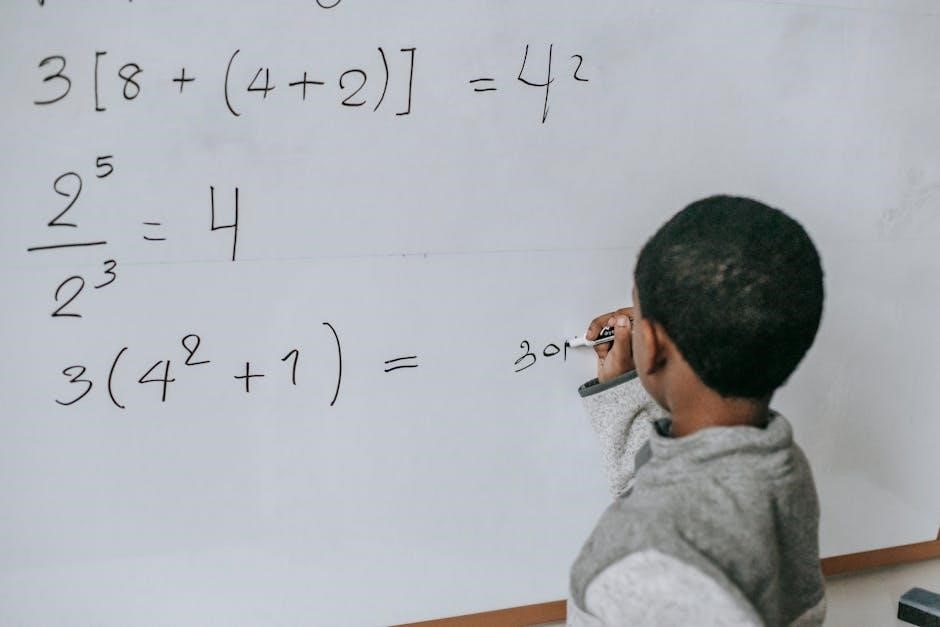
Worksheets should clearly indicate the value of each variable to avoid confusion. This introduction lays the groundwork for future algebraic concepts‚ demonstrating how order of operations remains crucial when dealing with variables and expressions.